ADA Certified Obtainable Portable Restrooms: Conformity Tips Based Upon Federal Rules
If you rent portable restrooms for a festival, public celebration, metropolitan site, church occasion, institution function, or personal venue available to the general public, ease of access is not a side issue. It shapes whether visitors can utilize the website with self-respect, whether staff spend the day solving preventable issues, and whether the coordinator has really fulfilled federal expectations as opposed to assuming they have.
I have seen this fail in very regular means. A group orders one bigger unit and really feels happy that they checked package. Then it reaches the edge of a gravel lot without secure route, a lip at the entrance, and one more conventional unit parked so near the door that becoming it comes to be awkward or impossible. On paper, they rented an ada mobile restroom. In technique, they developed an additional obstacle.
That space in between ordering and true use is where most problems live.
The government baseline right here originates from the 2010 ADA Specifications for Accessible Layout, as translated by the Department of Justice and the Gain Access To Board. Those rules matter for mobile toilet arrangements just as high as they do for permanent facilities. And when the setting is temporary, that does not make ease of access optional. Momentary events still need to obtain this right.
The policy many people miss out on first
For clusters of mobile single-user toilet devices, at least 5 percent of the devices in each collection need to be accessible. The Access Board has actually made clear that this applies even at temporary events.
That one sentence lugs even more weight than several occasion organizers understand. Words "collection" issues. If you spread systems across a huge website in different groups, you should think in terms of each team, not just the complete matter for the entire property. A solitary ada compliant mobile commode put in one far-off edge may not resolve access problems for the other restroom financial institutions people are in fact using.
This is one reason a casual strategy triggers problem. Individuals have a tendency to count all units on the site, divide by twenty, and quit there. Federal scoping is a lot more practical than that. It concentrates on the real collection being used. If one toilet area has a row of systems near the entrance and an additional row near the food solution area, access needs to be taken into consideration in each of those areas.
Even when a client requests for "one handicap system," I constantly urge them to shift the discussion. The concern is not whether there is a larger system someplace. The genuine question is whether each collection consists of the appropriate variety of accessible devices, effectively placed and in fact usable.
"ADA obtainable" is not just a bigger box
A lot of individuals use phrases like ada available mobile toilet or ada handicap easily accessible mobile restroom as if they just describe dimension. Federal rules are more demanding than that.
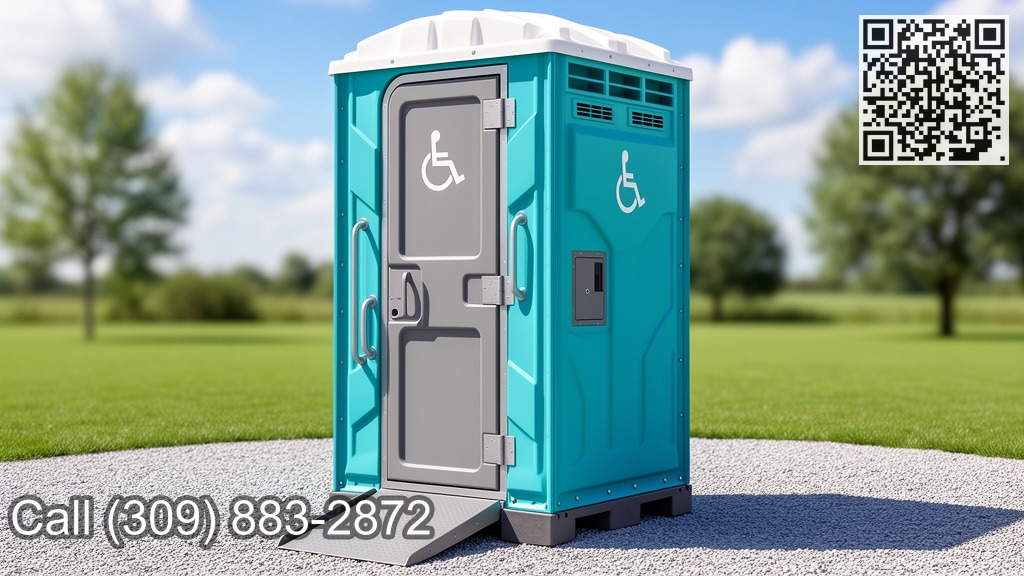
An easily accessible mobile bathroom unit need to be identified with the International Sign of Accessibility. It also needs to have an available course and entrance. If ramps or touchdowns are required, those aspects must follow ADA technological requirements. Past entering into the unit, the portable toilet itself has to fulfill toilet-room technological requirements, including fixture clearances, transforming area, door steering clearances, and applicable guidelines for grab bars and water-closet clearances.
That is a meaningful distinction. A roomy inside alone does not make an unit certified. Neither does a sales tag. Neither does a driver stating, "This is our ADA design."
In genuine job, one of the most reputable habit is to deal with availability as a chain. If one link fails, the customer experience stops working. An appropriately created ada certified portable washroom ends up being nonfunctional if the course to it is hard to reach. A right route does not assist if the unit lacks the best inner clearances. And even a practically proper device can end up being hard to use if positioning blocks the door swing or maneuvering area.
The route is where numerous arrangements fail
This is most likely the most usual area mistake because it is so ordinary. The device itself gets here compliant, but the ground conditions or bordering layout undo that compliance.
Portable restrooms commonly get positioned where there is space, not where there is accessibility. That might imply a soft grassy shoulder after rainfall, loose crushed rock, an incline that really feels manageable to able-bodied personnel but not to wheelchair users, or a route interrupted by hoses, momentary fence, cords, or crowd-control barricades.
Federal guidelines call for an accessible path and entrance. That implies the route is not a second thought. It is part of the demand. If you require a ramp or touchdown, that ramp or touchdown needs to adhere to ADA technical standards too.
This is where intending early pays off. By the time trucks are backing in and suppliers are staking their areas, the best available places are frequently gone. The easily accessible system then obtains pressed right into whatever space stays, which is specifically just how you wind up with a nominally compliant device offering a noncompliant website condition.
A straightforward mental examination assists. Picture a visitor showing up separately, without assistance, in a movement gadget. Can they get to the unit, approach the entrance, open and make use of the door, maneuver inside, and leave without a person improvising a solution? If not, the setup most likely requirements work.
Placement issues as long as procurement
I have actually viewed experienced site crews spend serious money on ada-compliant mobile washrooms and still create problems due to positioning. Sometimes the problem is crowding. In some cases it is grade. Occasionally it is poor circulation throughout a site. Typically it is a mix.
If you are organizing an ada portable toilet service, the rental order needs to never be the last ease of access choice. It is one step in a larger strategy. You also require to determine where the available systems belong, just how they will be come close to, what surfaces bring about them, and whether neighboring things interfere with use.
The positioning discussion ought to happen with the very same seriousness people enable, water, shipment, and emergency accessibility. Mobile sanitation often tends to get pressed throughout of planning, and access obtains pushed throughout of sanitation preparation. That series triggers preventable mistakes.
One useful technique is to walk the website before the delivery day, recognize every washroom cluster, and pick the easily accessible place initially. Afterwards, develop the rest of the cluster around it. When groups do the reverse, the available unit becomes whatever can still fit, which is hardly ever the very best answer.
Temporary occasion does not mean short-lived responsibility
Some coordinators still think that due to the fact that an occasion just lasts a day or a weekend, federal access standards unwind. That is not how the policy works right here. The Gain access to Board has especially said the 5 percent accessible-unit need uses also at temporary events.
That matters for fairs, races, civic parties, seasonal attractions, outside performances, and pop-up locations. If the public is being invited onto the site and mobile toilet clusters are being given, availability needs to be constructed into the strategy from the start.
The momentary nature of an occasion can really make compliance harder. Surface areas change. Weather condition transforms a convenient course into mud. Fence shifts. Suppliers expand right into nearby locations. Volunteers relocate signs or barriers. A route that appeared clear at 7 a.m. Can come to be blocked by noontime. So while the legal requirement is repaired, the functional challenge is dynamic.
That implies event-day monitoring issues. Accessibility is not only a delivery issue. It is also a site-management issue.
Construction websites need a cautious distinction
There is one area where people often overgeneralize. The ADA Standards identify mobile bathroom units at building websites made use of solely by building personnel. The pointed out 1991 basic dealt with those as exempt from the portable-toilet availability scoping requirement.
That exemption is narrow, and individuals often misapply it far past its context. It does not eliminate ease of access requirements for general portable bathroom services. It does not convert every jobsite setup into an exempt problem. And it absolutely does not put on public occasions, customer-facing areas, or mobile bathroom banks serving people besides building personnel.
The most safe way to think about it is this: if you are taking care of general use portable restroom leasings, assume the accessible-unit requirement applies unless you have really certain legal premises showing or else. Informal presumptions based on "it's a work site" are risky, particularly when the site includes site visitors, customers, inspectors, or any non-construction users.
What "certified" should mean when you speak to a vendor
The mobile sanitation sector utilizes a mix of terms. You will certainly hear ada compliant portable commode, ada-compliant mobile commode, ada certified mobile toilets, and ada compliant obtainable portable washrooms utilized practically reciprocally. That is easy to understand in normal conversation, yet when you are renting, accuracy helps.
You are not simply requesting for a bigger design. You are requesting for a system meant to fulfill the applicable accessibility needs and for a shipment setup that supports real conformity on site. Those are related, but they are not identical.
A solid supplier discussion typically covers three useful factors. First, validate that the unit provided is the easily accessible version intended for ADA use. Second, discuss where the system will be placed so the route and entry can work in the actual website problems. Third, validate that the device will be understood the International Icon of Accessibility.
If any of those factors feel unclear in the conversation, decrease. Obscure answers early usually end up being area migraines later.
The most common conformity mistakes I see
- Counting available units across the entire website instead of within each toilet cluster
- Ordering an ada accessible portable washroom however positioning it on an inaccessible route
- Forgetting that momentary events still need to meet the accessible-unit scoping rule
- Assuming "bigger unit" automatically suggests practically compliant
- Blocking door technique or maneuvering space with neighboring systems, fence, or site equipment
None of these mistakes are dramatic by themselves, which is why they take place so usually. They are planning errors, not normally negative intents. Yet from the user's viewpoint, the result coincides. A restroom that can not be gotten to or used individually is not serving its purpose.
The role of signs and identification
Identification matters more than many groups expect. Accessible systems need to be marked with the International Icon of Accessibility. That might seem noticeable, however on busy websites, noticeable recognition reduces complication for visitors and personnel alike.
Without clear noting, people may not know which unit is planned to be easily accessible, specifically in a large financial institution where systems look similar from a range. Personnel might mistakenly redirect guests improperly. Groups might develop around the incorrect location. In low light or on a vast event footprint, good recognition conserves time and stress.
That claimed, signage is not a substitute for accessibility. I state this due to the fact that some configurations overcompensate with tags while neglecting path and placement. A popular sign on the door does not deal with an inaccessible entry or missing steering clearance.
Interior compliance is technological, which matters
The Accessibility Board advice makes clear that mobile commode systems should fulfill toilet-room technological needs. That consists of fixture clearances, turning area, door steering clearances, and appropriate grab-bar and water-closet clearance rules.
Those information are technical for a reason. They are what make independent use possible. A customer may require area to turn, technique, transfer, maintain, and operate the door without awkward contortions or outside aid. If the inner design falls short on those points, the restroom may still look large to somebody standing in the doorway while remaining very hard to use.
Because the confirmed federal context here does not supply the specific dimensional needs, it would certainly be irresponsible to think or existing numbers casually. The sensible takeaway is that buyers and tenants ought to not depend on advertising language alone. They should request the available version meant to please ADA needs and confirm that the system spec aligns with those technical standards.
That is particularly vital when fleets vary. Some vendors have older systems, combined inventories, or local naming practices that do not completely associate federal terms. "Handicap device" in a dispatch note is not a technical standard. Clear verification is better.
A short preparation checklist that protects against pricey fixes
- Identify each restroom cluster on the site map before ordering units
- Reserve the available area in each cluster initially, not last
- Check the course, entryway, and any type of required ramp or landing problems prior to delivery
- Confirm the unit is noted with the International Sign of Accessibility
- Recheck accessibility after arrangement, specifically if fencing, cable televisions, or weather conditions change
This sort of list saves money due to the fact that one of the most expensive access solutions are usually last-minute repairs. Relocating devices after distribution, reconstructing gain access to courses throughout an occasion, or fielding complaints as soon as guests have actually shown up all expense greater than preparing thoroughly at the start.
Accessibility is progressively part of a broader conformity culture
Even though portable toilet compliance follows its own federal accessibility policies, it is worth observing the broader instructions of enforcement. Access assumptions are not diminishing. They are coming to be much more visible throughout sectors.
Recent federal support activity around internet and mobile ease of access for state and local government entities shows that bigger setting. Different accessibility obligations apply in various setups, however the common thread is that compliance is energetic, not inactive. Organizations that still deal with ADA concerns as trivialities lag the curve.
That broader environment affects just how portable sanitation choices are seen. A site group that is currently servicing easily accessible auto parking, courses, entries, ticketing, seating, or digital gain access to ought to think of available portable restrooms as part of the very same operational standard. Guests do not experience conformity in silos. They experience the site as a whole.
When judgment matters more than minimal math
Meeting the 5 percent guideline is the floor for clustered single-user portable devices, not the ceiling of great preparation. Occasionally minimal conformity suffices. Often it is not.
A stretching occasion with long strolling distances may practically satisfy the percent while still creating sensible concerns if available devices are improperly dispersed. A website serving a populace that is likely to have greater access requirements may make a decision that supplying just the minimum is shortsighted. A collection near the major entry may deserve even more attention than a lightly made use of remote bank.
That is not designing a new government guideline. It is simply functional judgment. Good planners understand the difference in between bare minimum scoping and a setup that really functions well under actual conditions.
I have seen organizers prevent a lot of tension by asking one humane concern early: if a guest making use of a wheelchair shows up throughout optimal website traffic, where will they reasonably go, and what will that experience feel like? That inquiry often tends to reveal design troubles much faster than abstract compliance talk.
Better toilet gain access to typically originates from earlier conversations
The smoothest easily accessible bathroom arrangements generally share the exact same quality. Someone brought the concern up early, before trucks rolled, before betting, prior to fence, before the nicest level locations were taken.
That very early conversation does not need to be remarkable. It simply needs to be certain. The number of collections exist? Which units in each cluster will be accessible? What course obtains a person there? Is the entrance functional in the real website condition, not the suitable one? Will the system be clearly determined? Has any individual thought about what takes place if it rains?
Those are normal preparation questions. However when they are left unanswered, the outcome is commonly a site that technically attempted and practically failed.
The excellent information is that accessible portable washroom compliance is convenient when teams treat it as component of the site strategy, not as a https://jaidenfcvt040.tearosediner.net/ada-portable-bathroom-rental-checklist-for-accessibility-conformity final add-on. If you are buying an ada mobile bathroom or numerous ada certified mobile bathrooms, focus on the full chain: the ideal number in each cluster, the right device, the right route, the appropriate entrance, the ideal internal attributes, and the right identification.
That is what federal compliance resembles on the ground. More crucial, it is what regard for your visitors appears like too.
 Ask ChatGPT
 Ask Grok
 Ask Perplexity
 Ask Claude
 Ask Google AI
 Ask You